









00:00:00 / 00:00:00

Challenges in unsupervised learning: statistical-computational trade-offs - Lecture 2

By Alexandra Carpentier

Appears in collection : New challenges in high-dimensional statistics / Statistique mathématique 2025

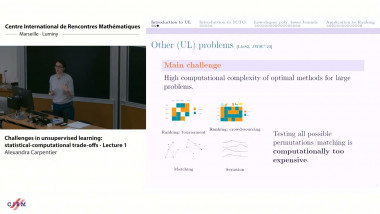
Unsupervised learning is a central challenge in artificial intelligence, lying at the intersection of statistics and machine learning. The goal is to uncover patterns in unlabelled data by designing learning algorithms that are both computationally efficient—that is, run in polynomial time—and statistically effective, meaning they minimize a relevant error criterion. Over the past decade, significant progress has been made in understanding statistical–computational trade-offs: for certain canonical « vanilla » problems, it is now widely believed that no algorithm can achieve both statistical optimality and computational efficiency. However, somewhat surprisingly, many extensions of these widely accepted conjectures to slightly modified models have recently been proven false. These variations introduce additional structure that can be exploited to bypass the presumed limitations. In these talks, I will begin by presenting a vanilla problem for which a statistical computational trade-off is strongly conjectured. I will then discuss a specific class of more complex unsupervised learning problems namely, ranking problems in which extensions of the standard conjectures have been refuted, and I will aim to explain the underlying reasons why.

Information about the video

Citation data

  • DOI 10.24350/CIRM.V.20431303
  • Cite this video Carpentier, Alexandra (18/12/2025). Challenges in unsupervised learning: statistical-computational trade-offs - Lecture 2. CIRM. Audiovisual resource. DOI: 10.24350/CIRM.V.20431303
  • URL https://dx.doi.org/10.24350/CIRM.V.20431303

Domain(s)

Last related questions on MathOverflow

You have to connect your Carmin.tv account with mathoverflow to add question

Ask a question on MathOverflow


Register

  • Bookmark videos
  • Add videos to see later &
    keep your browsing history
  • Comment with the scientific
    community
  • Get notification updates
    for your favorite subjects
Give feedback