








Summer School 2024 - Low dimensional Topology

Collection Summer School 2024 - Low dimensional Topology

Organisateur(s) Scientific Committee: Greg Kuperberg, Christine Lescop, Gwénaël Massuyeau, Jean-Baptiste Meilhan / Organization Committee: Christine Lescop, Gwénaël Massuyeau, Jean-Baptiste Meilhan
Date(s) 17/06/2024 - 05/07/2024
URL associée https://if-summer2024.sciencesconf.org
00:00:00 / 00:00:00
30 42

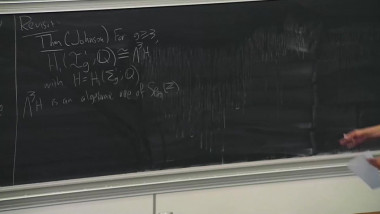
A family of groups G_n satisfies homological stability if the d-th homology group of G_n is independent of n when n is big enough. The part of the homology that becomes independent of n corresponds to the stable homology. It turns out that the stable homology is often easier to compute that unstable homology. Combining the computation of the stable homology and homological stability we obtain explicit computations of homology of the groups G_n for n big enough. Homological stability is a very common phenomenon. For example, symmetric groups and braid groups satisfy homological stability. By Harer's theorem, the family of mapping class groups satisfies homological stability. The stable homology of the mapping class groups is computed by Madsen and Weiss, giving a proof of the Mumford conjecture. Homological stability and stable homology can also be considered for twisted coefficients. More precisely, for G_n-modules M_n, we can consider the homology of G_n with coefficients in M_n: H_*(G_n,M_n). For a nice family of groups G_n and for modules M_n coming from a functor satisfying a polynomial property, this satisfies homological stability. The part of the homology that becomes independent of n corresponds to the twisted stable homology. It turns out that the twisted stable homology of a nice family of groups G_n can be computed from two ingredients: the stable homology of G_n and functor homology. Functor homology is a short way to talk about homological algebra in functor categories. There are many parallels between mapping class groups and automorphisms groups of free groups so this course will focus on the homology of these two families of groups.
Informations sur la vidéo

Dernières questions liées sur MathOverflow

Pour poser une question, votre compte Carmin.tv doit être connecté à mathoverflow

Poser une question sur MathOverflow


Inscrivez-vous

  • Mettez des vidéos en favori
  • Ajoutez des vidéos à regarder plus tard &
    conservez votre historique de consultation
  • Commentez avec la communauté
    scientifique
  • Recevez des notifications de mise à jour
    de vos sujets favoris
Donner son avis