








48:37
published on June 10, 2026
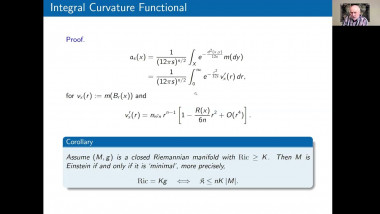
Gaussian Volume Functional, Integral Scalar Curvature, and Minimal Super-Ricci Flows
By Karl-Theodeor Sturm
![[1955] Les notes fondamentales des surfaces hyperboliques aléatoires de grand genre](/media/cache/video_light/uploads/video/SeminaireBourbaki.png)
published on June 9, 2026
[1955] Les notes fondamentales des surfaces hyperboliques aléatoires de grand genre
By Bram Petri
40:18
published on May 26, 2026
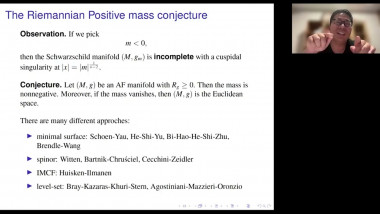
A proof of Riemannian positive mass theorem up to dimension 19
By Jintian Zhu