Arguably, water is the most important resource for mankind. It is essential from our food production down to our industrial activities. Managing our water resources has been essential for the development of our societies since ancient history. In modern society, our ability to control the availability of water is key for agriculture, life in cities, transport and energy production. These achievements are a success of engineering sciences and our ability to observe nature. Climate change is an unintentional consequence of the development of our societies. But as water is a key element of the thermodynamics of the Earth system, climate change will fundamentally alter the water cycle and our resources. As the organisation of our society is so closely linked to water availability, the impact of climate change on our resources will have wide ranging consequences. Understanding and predicting these consequences is a fundamental multi-disciplinary endeavour.
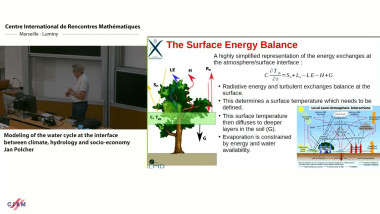
To this end the development of appropriate tools and monitor the current state and predict their future evolution in a changing climate are needed to guide our management. At the land surfaces the energy, water and carbon cycles are tightly coupled and thus one cannot be simulated without the other. In contrast to the current generation of climate models, we cannot make the assumption that the system is natural any more. Thus, we need to prepare modelling tools which also envision an evolution of how we manage our resources in an evolving system. The presentation will make the case that a new paradigm is needed which tightly couples the natural cycles with the socioeconomic constraint on the usage of the resources. This will be achieved by reviewing the current modelling strategies, their failures and how they are being overcome.