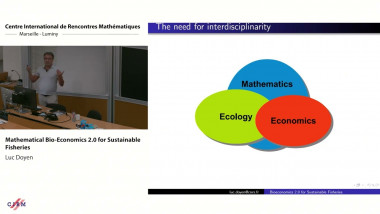
Reconciling food security, economic development and biodiversity conservation in the face of global changes is a major challenge. The sustainable uses of marine biodiversity in the context of climate change, invasive species, water pollution and demographic growth is an example of this bio-economic challenge. There is a need for quantitative methods, models, scenarios and indicators to support policies addressing this issue. Although bio-economic models for marine resources date back to the 1950s and are still used in fisheries management and policy design, they need major improvements, extensions and breakthroughs. Our presentation designs a Mathematical Bio-Economics 2.0 (MBE2) for Sustainable Fisheries in order to advance the development of bio-economic models and scenarios for the management of fisheries and marine ecosystems confronted with unprecedented global change. These models and scenarios should make both ecological and economic senses while being well-posed mathematically and numerically. To achieve this, we propose to base the MBE2 framework for Sustainable Fisheries on four research axes regarding the mathematics and modeling of : (i) ecosystem-based f isheries management; (ii) criteria of sustainability; (iii) criteria of resilience; (iv) governance and strategic interactions. The associated methodology of MBE2 draws mainly on dynamic systems theory, optimal and viable controls of systems, game theory and stochastic approaches. Our analysis, based on these four axes, allows us to identify the main methodological gaps to fill compared to current models for fisheries management. The presentation brings together theoretical findings and applications to f isheries worldwide.