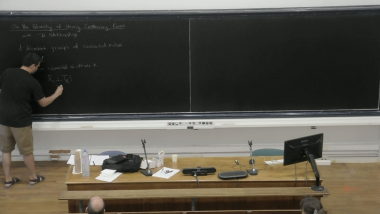






2026 - T2 - WS3 - Idealised mathematical models for geophysical flows

Collection 2026 - T2 - WS3 - Idealised mathematical models for geophysical flows

Organizer(s) Dormy, Emmanuel ; Lacave, Christophe ; Oruba, Ludivine ; Vasseur, Alexis
Date(s) 29/06/2026 - 03/07/2026
linked URL https://indico.math.cnrs.fr/event/13870/
25 32

How to determine the speed and amplitude of the leading edge of a dispersive shock wave

By Sergey Gavrilyuk

The objective of my talk is to describe the solitary wave of largest amplitude in the dispersive shock appearing in the solution of Riemann problem for dispersive equations describing non-linear long dispersive waves, in particular, the Benjamin-Bona-Mahony equation and Serre-Green-Naghdi equations. Such a large-amplitude solitary wave is the leading wave of the corresponding dispersive shock. Its speed and amplitude are defined analytically through the solitary limit of the corresponding Whitham modulation equations. In such a limit, Whitham's equations form a system of quasi-linear equations for which Riemann's invariants can be determined. The numerical results are in accordance with the analytical prediction.

Information about the video

Citation data

  • DOI 10.57987/IHP.2026.T2.WS3.020
  • Cite this video Gavrilyuk, Sergey (02/07/2026). How to determine the speed and amplitude of the leading edge of a dispersive shock wave. IHP. Audiovisual resource. DOI: 10.57987/IHP.2026.T2.WS3.020
  • URL https://dx.doi.org/10.57987/IHP.2026.T2.WS3.020

Last related questions on MathOverflow

You have to connect your Carmin.tv account with mathoverflow to add question

Ask a question on MathOverflow


Register

  • Bookmark videos
  • Add videos to see later &
    keep your browsing history
  • Comment with the scientific
    community
  • Get notification updates
    for your favorite subjects
Subscribe illustration
Give feedback