Appears in collection : CEMRACS 2026 : Modeling and AI for Environmental Transition / Centre d'Eté Mathématique de Recherche Avancée en Calcul Scientifique
Climate change is poised to profoundly transform many aspects of our society, making its mitigation and adaptation an urgent priority. Physicists and mathematicians have a crucial role to play in addressing these challenges. The theoretical foundations of climate science form a highly multidisciplinary field, drawing from statistical physics, mathematics, data and computer science, hydrodynamics, and turbulence. In thiese lectures, I will explore several examples where statistical physics and large deviation theory provide valuable insights into fundamental problems in climate dynamics.
In this talk, I will explore several examples where statistical physics and large deviation theory provide valuable insights into fundamental problems in climate dynamics. The first example focuses on a theoretical contribution to the kinetic theory of wave turbulence. Wave turbulence plays a key role in atmosphere-ocean interactions and in mixing properties of the ocean's interior. I will show how large deviation theory extends the classical framework, allowing us to quantify the effects of both typical and rare spontaneous fluctuations. This, in turn, provides a foundation for stochastic parameterization of wave energy propagation.
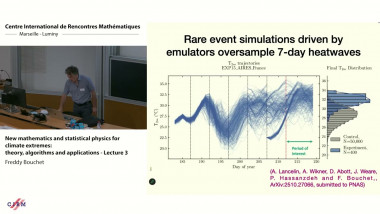
A significant portion of the talk will be dedicated to extreme heat waves. Understanding extreme events and transitions between climate attractors is essential for assessing the impacts of climate change. Recent extreme heat waves, with devastating consequences, exemplify this urgency. However, conventional approaches struggle to analyze these phenomena due to their rarity and the complexity of realistic climate models. I will introduce novel algorithms and theoretical methods—rooted in large deviation theory, rare event simulations, and machine learning for stochastic processes—designed specifically to predict extreme heat waves. Using state-of-the-art climate models, our approach sheds new light on the fluid dynamics that drives these events. In particular, I will describe quasi-stationary patterns of turbulent Rossby waves that generate global teleconnection patterns linked to heat waves and analyze their dynamics.
To conclude, I will briefly outline ongoing projects that apply these same tools to the study of extreme fluctuations in renewable energy production and their connection to climate dynamics. Understanding these rare events is critical for the future stability of the European electricity system.