







2026 - T1 - WS3 - Integrating Research and Illustration in Number Theory

Collection 2026 - T1 - WS3 - Integrating Research and Illustration in Number Theory

Organizer(s) Caruso, Xavier ; Eischen, Ellen ; Hsu, Catherine ; Stange, Katherine E.
Date(s) 23/03/2026 - 27/03/2026
linked URL https://indico.math.cnrs.fr/event/16261/
14 20

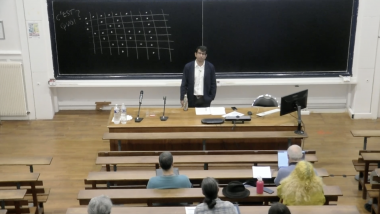
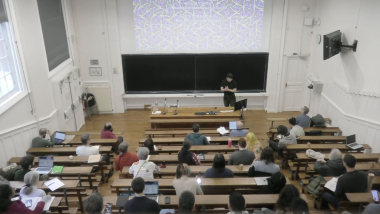
Aperiodic tilings and polygonal partitions of the torus

By Sébastien Labbé

De Bruijn proved in the early 1980's that Penrose aperiodic tilings can be constructed from a method based on multigrids. As observed by Moody and Lagarias in the 1990's, this method, now known as cut and project scheme, was originally formalized by Meyer in 1970's. A cut and project scheme includes a physical space (the space we want to tile) and an internal space (an additional helpful coordinate space).

Many known aperiodic tilings are 4-to-2 cut-and-project schemes, meaning that the dimension of both spaces is 2. These include Penrose tilings, the Ammann tilings, the Jeandel-Rao tilings and tilings by the hat monotile. The goal of this talk is to explain and understand aperiodic tilings coming from 4-to-2 cut and project schemes with illustrations, experimentations, discussions and using as many senses as possible (sight, hearing, touch, smell and taste) but mostly the first three.

Information about the video

Citation data

  • DOI 10.57987/IHP.2026.T1.WS3.013
  • Cite this video Labbé, Sébastien (26/03/2026). Aperiodic tilings and polygonal partitions of the torus. IHP. Audiovisual resource. DOI: 10.57987/IHP.2026.T1.WS3.013
  • URL https://dx.doi.org/10.57987/IHP.2026.T1.WS3.013

Domain(s)

Last related questions on MathOverflow

You have to connect your Carmin.tv account with mathoverflow to add question

Ask a question on MathOverflow


Register

  • Bookmark videos
  • Add videos to see later &
    keep your browsing history
  • Comment with the scientific
    community
  • Get notification updates
    for your favorite subjects
Give feedback