







45:51
published on October 13, 2026
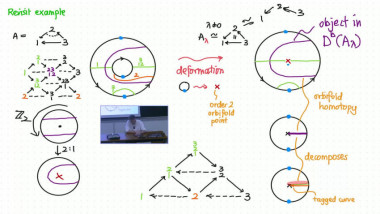
Deformations of graded gentle algebras and Fukaya categories of surfaces
By Barmeier Severin

By Frank Loray
Appears in collection : Summer School 2019 - Foliations and algebraic geometry
In these lectures, we use the material of V. Heu and H. Reis' lectures to introduce and study Painlevé equations from the isomonodromic point of view. The main objects are rank 2 systems of linear differential equations on the Riemann sphere, or more generally, rank 2 connections. We will mainly focus on the case they have 4 simple poles, corresponding to the Painlevé VI equation, while other Painlevé equations correspond to confluence of these poles.First, we settle the Riemann-Hilbert correspondance which establish, roughly speaking, a one-to-one correspondance between connections and their monodromy data, once the poles are fixed. This correspondance is analytic, but not algebraic, very transcendental. Then isomonodromic deformations arise when we deform poles and connection without deforming the monodromy representation. Although the deformation is also transcendental in general, the coefficients satisfy a non linear polynomial differential equation, namely the Painlevé VI equation. By constructing an universal isomonodromic deformation, we explain how Malgrange proved the Painlevé property for isomonodromic deformation equations: solutions admit analytic continuation (with poles) outside of a fixed singular set. At the end, we can describe the Okamoto space of initial conditions for Painlevé VI equation, as well as its non linear monodromy. This can be used to prove the irreductibility of Painlevé VI equation, i.e. the absence of special first integrals, and therefore the transcendance of the general solution.
By Barmeier Severin