Appears in collection : Mathematical aspects of the physics with non-self-adjoint operators / Les aspects mathématiques de la physique avec les opérateurs non-auto-adjoints
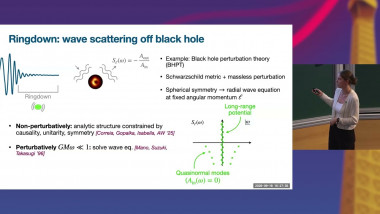
In this talk we present two physical problems, framed in a gravitational setting, defined in terms of non-selfadjoint operators. Specifically, such problems address spectral and dynamical properties of black holes described in general relativity. The first one focuses on a notion of stability for the apparent horizon of a black hole, controlled by the spectrum of the so-called MOTS-stability operator, a non-selfadjoint operator in the rotating case. The characterisation of the qualitative properties of its spectrum is of relevance in different black hole settings. The second problem concerns the linear dynamical regime in the evolution of black holes close to equilibrium. Adopting a hyperboloidal spacetime slicing description to enforce outgoing boundary conditions, the infinitesimal time generator is cast as a non-selfadjoint operator. This feature results in the spectral instability of the so-called quasi-normal mode frequencies, a potential issue for the "black hole spectroscopy programme" in gravitational wave physics. Beyond these spectral aspects, non-modal dynamical effects as growth transients or pseudo-resonances are also the subject of ongoing research in the merger of black holes. These examples provide two open problems in gravitational physics where the input of expertise in non-selfadoint operator theory seems crucial. Finally, as a sort of disclaimer, our emphasis in the physics somehow reverses the spirit in the conference's title, in what could be rather paraphrased as "physical aspects of the mathematicswith non-self-adjoint operators.