








00:00:00 / 00:00:00

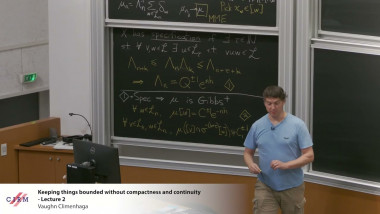
Keeping things bounded without compactness and continuity - Lecture 1

By Vaughn Climenhaga

Appears in collection : New directions in thermodynamic formalism / Nouvelles orientations pour le formalisme thermodynamique

Thermodynamic formalism involves many quantities that grow or decay exponentially fast. Comparing quantities with the same exponential rate results in ratios that are permitted to grow or decay sub-exponentially. A recurring theme is that when the underlying system is "sufficiently hyperbolic", many of these ratios turn out to be bounded away from 0 and infinity. The resulting uniform ratio bounds are central to the study of the measure of maximal entropy and other equilibrium measures. In these lectures, I will survey some of these bounds, their proofs, and their consequences for existence, uniqueness, and other results in thermodynamic formalism. In particular, I will describe recent work that extends this story beyond the classical setting of continuous systems on compact spaces. This includes geodesic flows on non-compact negatively curved manifolds under a strong positive recurrence condition, using a version of Bowen's specification property, and also includes Sinai billiard maps using growth-fragmentation lemmas and a Hausdorff measure construction.

Information about the video

Citation data

  • DOI 10.24350/CIRM.V.20506003
  • Cite this video Climenhaga, Vaughn (23/06/2026). Keeping things bounded without compactness and continuity - Lecture 1. CIRM. Audiovisual resource. DOI: 10.24350/CIRM.V.20506003
  • URL https://dx.doi.org/10.24350/CIRM.V.20506003

Domain(s)

Bibliography

  • CLIMENHAGA, Vaughn et DAY, Jason. Every finite horizon Sinai billiard map has a unique measure of maximal entropy. arXiv preprint arXiv:2604.25881, 2026. - https://doi.org/10.48550/arXiv.2604.25881
  • CLIMENHAGA, Vaughn, THOMPSON, Daniel J., et WANG, Tianyu. Thermodynamic formalism for non-compact systems with expansivity and specification. arXiv preprint arXiv:2606.20405, 2026. - https://doi.org/10.48550/arXiv.2606.20405

Last related questions on MathOverflow

You have to connect your Carmin.tv account with mathoverflow to add question

Ask a question on MathOverflow


Register

  • Bookmark videos
  • Add videos to see later &
    keep your browsing history
  • Comment with the scientific
    community
  • Get notification updates
    for your favorite subjects
Subscribe illustration
Give feedback