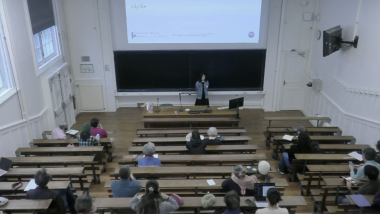
Embedding high-dimensional data into (non-)Euclidean spaces (fast)

By Martin Skrodzki

Appears in collection : 2026 - T1 - WS2 - Bridging visualization and understanding in Geometry and Topology

The field of explorative data analysis provides methods to investigate large, potentially high-dimensional, data sets. Such exploration is best done visually, to engage the human in the loop with all pattern recognition built into our visual cortex. In my talk, I will give a brief introduction to dimensionality reduction for this purpose, especially about the t-SNE method. I will then show how embedding into non-Euclidean spaces can provide embeddings that help with visual inspection and how to compute such embeddings quickly.

Information about the video

Citation data

  • DOI 10.57987/IHP.2026.T1.WS2.003
  • Cite this video Skrodzki, Martin (16/02/2026). Embedding high-dimensional data into (non-)Euclidean spaces (fast). IHP. Audiovisual resource. DOI: 10.57987/IHP.2026.T1.WS2.003
  • URL https://dx.doi.org/10.57987/IHP.2026.T1.WS2.003

Bibliography

  • Maaten, Laurens van der, and Geoffrey Hinton. "Visualizing data using t-SNE." Journal of machine learning research 9.Nov (2008): 2579-2605.
  • Van Der Maaten, Laurens. "Accelerating t-SNE using tree-based algorithms." The journal of machine learning research 15.1 (2014): 3221-3245.
  • Klimovskaia, Anna, et al. "Poincaré maps for analyzing complex hierarchies in single-cell data." Nature communications 11.1 (2020): 2966.
  • Skrodzki, Martin, et al. "Accelerating hyperbolic t-SNE." IEEE transactions on visualization and computer graphics 30.7 (2024): 4403-4415.

Last related questions on MathOverflow

You have to connect your Carmin.tv account with mathoverflow to add question

Ask a question on MathOverflow


Register

  • Bookmark videos
  • Add videos to see later &
    keep your browsing history
  • Comment with the scientific
    community
  • Get notification updates
    for your favorite subjects
Give feedback