





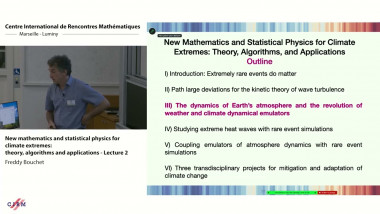
01:30:14
publiée le 3 août 2026
New mathematics and statistical physics for climate extremes: theory, algorithms and applications - Lecture 2
De Freddy Bouchet
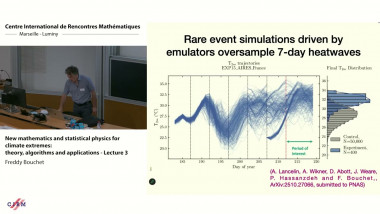
01:33:07
publiée le 3 août 2026
New mathematics and statistical physics for climate extremes: theory, algorithms and applications - Lecture 3
De Freddy Bouchet
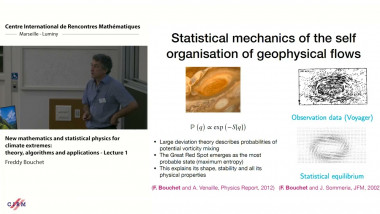
01:30:28
publiée le 3 août 2026
New mathematics and statistical physics for climate extremes: theory, algorithms and applications - Lecture 1
De Freddy Bouchet
publiée le 7 juillet 2026
Boundary conditions and non kinematic free boundaries for wave-structure interactions
De David Lannes