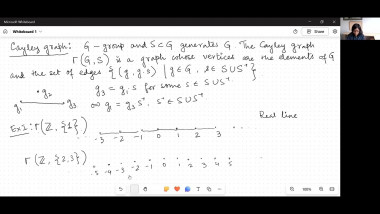
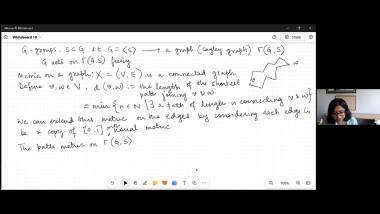
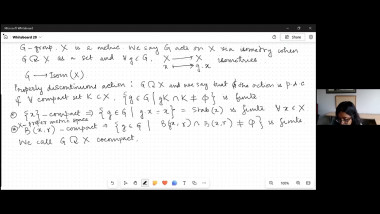
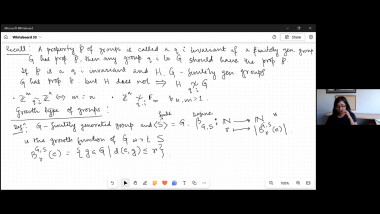
This course aims to introduce the foundational ideas of Geometric Group Theory, focusing on the interplay between algebraic and geometric properties of finitely generated groups. The central theme is to view groups as geometric objects and study how their large-scale geometric structure reflects and influences their algebraic behavior. We begin by associating to each finitely generated group a metric space via its Cayley graph, equipped with the word metric. This construction enables us to analyze groups from a geometric standpoint. We then introduce the concept of quasi-isometry, a coarse equivalence between metric spaces that preserves their large-scale geometry. A central result in this theory is the Milnor–Schwarz Lemma, which states that if a group G acts properly discontinuously, cocompactly, and isometrically on a proper geodesic metric space X, then G is quasi-isometric to X. This result formalizes the idea that the large-scale geometry of a group is determined by the geometry of the space on which it acts geometrically. Having established a functorial association geo : {Finitely generated groups} −→ {Metric spaces up to quasi-isometry}, we will investigate the extent to which this association is injective. This question forms the basis for the study of quasi-isometric rigidity. In this context, we will study various quasi-isometry invariants of groups, such as growth, space of ends that can distinguish groups up to quasi-isometry.