









French Spring School in Theoretical Computer Science / École de Printemps d'Informatique Théorique

Collection French Spring School in Theoretical Computer Science / École de Printemps d'Informatique Théorique

Organisateur(s) Baudart, Guillaume ; Pagani, Michele ; Petrisan, Daniela ; Tasson, Christine
Date(s) 11/05/2026 - 15/05/2026
URL associée https://conferences.cirm-math.fr/3489.html
00:00:00 / 00:00:00
4 5

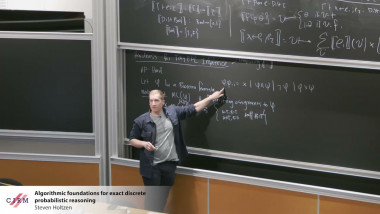
Algorithmic foundations for exact discrete probabilistic reasoning

De Steven Holtzen

This is a course on the “assembly language” of probabilistic programming languages: the nuts and bolts of low-level algorithms for efficiently implementing exact probabilistic inference in the discrete finite-support setting. Probabilistic inference is extremely computationally hard: inference is #P-hard even for very restricted probabilistic programming languages. Due to this hardness, inference walks a fine line: one must carefully carve out classes of tractable problem instances and design algorithms to exploit whatever tractable footholds one can find. First, we will study classical approaches to exact inference: variable elimination and the join-tree algorithm. Next, we will study knowledge compilation, including binary decision diagrams, sentential decision diagrams, and top-down and bottom-up compilation. Third, we will study pragmatics, and discuss how we should benchmark, evaluate, and design probabilistic reasoning algorithms to support users.

Informations sur la vidéo

Données de citation

  • DOI 10.24350/CIRM.V.20480703
  • Citer cette vidéo Holtzen, Steven (12/05/2026). Algorithmic foundations for exact discrete probabilistic reasoning. CIRM. Audiovisual resource. DOI: 10.24350/CIRM.V.20480703
  • URL https://dx.doi.org/10.24350/CIRM.V.20480703

Dernières questions liées sur MathOverflow

Pour poser une question, votre compte Carmin.tv doit être connecté à mathoverflow

Poser une question sur MathOverflow


Inscrivez-vous

  • Mettez des vidéos en favori
  • Ajoutez des vidéos à regarder plus tard &
    conservez votre historique de consultation
  • Commentez avec la communauté
    scientifique
  • Recevez des notifications de mise à jour
    de vos sujets favoris
Donner son avis